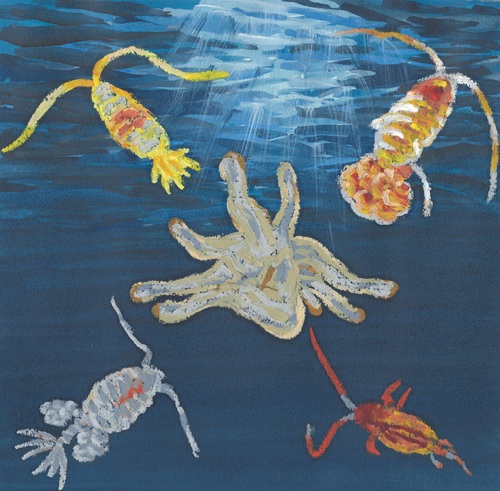
Plankton does not refer to a species but a way of life. They are drifters. They are the tiny, often microscopic, creatures that cannot swim against tides and currents. They go with the flow of the ocean. For something so small, it is hard to overestimate how important they are.
Plankton are divided into two categories. The first is phytoplankton, which are plants comprising millions of species. A sub-group of phytoplankton is diatoms. The glass-like shells of these single-celled organisms have have inspired artists for centuries, much like snowflakes have. The second group is dinoflagellates, which have tails that propel them through water. Phytoplankton live near the surface of the ocean turning light into energy, much like land plants do.
The second category of plankton, zooplankton, are animals comprising thousands of species. Some stay small their whole lives. Others are fish, squid, or crustacean larvae, who are considered plankton until they grow large enough to swim actively.
Plankton play two important roles in the world. First, plankton are the foundation of the food web. Zooplankton eat phytoplankton, and other animals eat zooplankton. Second, plankton remove carbon from the atmosphere. Phytoplankton do this through photosynthesis. Zooplankton contribute by eating and excreting phytoplankton, sending carbon downwards. All plankton sequester carbon when they die and fall into the deep ocean. The bottom of the Pacific Ocean, where the water is old, is filled with their remains. It is a veritable diatom graveyard.
Plankton appear in the story sometimes as a unified voice, and sometimes as three different voices. They play a role similar to the theater’s Greek chorus, which serves as a bridge to the audience to explain what’s happening. Plankton in Drowned Mermaid story accept their liminal role as food very seriously, if not lightheartedly.
Noctiluca: Noctiluca scintillans create beautiful bright blue bioluminescence. It is a type of dinoflagellate. Unfortunately in large volumes, they make up harmful algal blooms that negatively impact marine life by depleting oxygen and changing the chemical composition of the water. The character of Noctiluca is portrayed as a diva — flashy, and possibly a little bit toxic.
Meroplankton: This is a category of Zooplankton that are plankton as larvae, but they will mature into larger animals. For this reason, the character of Meroplankton has the childlike quality of someone who is new to life. It is curious, enthusiastic, and naive.
Copepod: Copepods are like sea bugs, and they are plentiful. For many marine science students, they are the first introduction to plankton when they look into a microscope. The character of Copepod is self-confident and a little cantankerous. As one of the most abundant animals on Earth, it believes it has a right to an opinion.