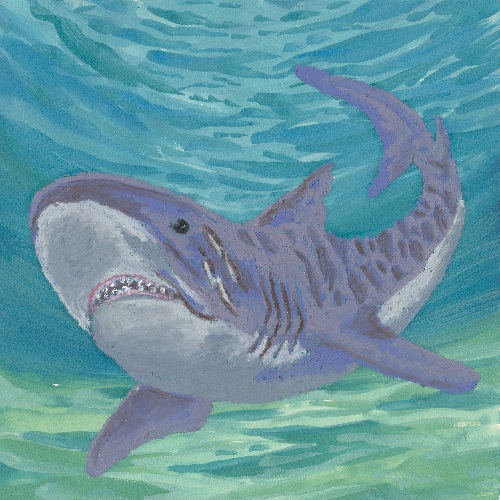
The character of Shark was inspired by the tiger shark (Galeocerdo cuvier), one of the largest sharks in the world. Tiger sharks measure 11 to 14 feet. Females, which sometimes exceed 18 feet, are larger than males.
Tiger sharks inhabit tropical to temperate oceans worldwide, but the Shark in this story is drawn from what we know about tiger sharks in Hawaiian waters. Though they have been recorded at depths of 1,000 feet, tiger sharks are considered coastal animals. They inhabit reefs, lagoons, river mouths, and estuaries.
Tiger sharks have earned the informal nickname “garbage cans of the sea,” because of their varied diets that include what you would expect like fish, squid, and crustaceans. But researchers have also found cats, mongoose and other terrestrial animals in their stomachs. More troubling are the indigestible items, like clothing, tin foil and plastic bags. Tiger sharks prey on vulnerable animals and overpopulated species. It is a keystone species, which keeps the ecosystem balanced.
Tiger sharks mate to reproduce. There is no bond between pairs. Females carry eggs internally, and gestation lasts 15 to 16 months. During that time, the developing young first feed on yolk within their eggs, and then when they hatch, on fluid inside the uterus. If there aren’t enough resources in utero, they can even feed on each other. They are born as fully formed, independent pups. Tiger sharks reproduce only once every three years. That slow reproductive cycle is a conservation concern: if populations decline, recovery takes a long time.
In Drowned Mermaid, these attributes shape a character named Shark — part mentor, part adversary. Through a series of challenges, Shark teaches Morgan hunting skills by modeling them, a relationship that has no parallel in the wild. Real tiger sharks are born already equipped to hunt. The dynamic between Morgan and Shark is fiction. One should never approach a tiger shark, whose behavior towards humans is unpredictable.